
Free eBook from BeamReaders
The Traffic Light Protocol for OMR Referral
A Practical Guide to Managing Risk, Improving Patient Outcomes, and Driving Practice ROI.
With case contributions from oral and maxillofacial radiologists Drs. Andrew Pakchoian, Anne Dorsey, Srinitha Singanamala, and Boulos Bechara, and with clinical review by Dr. Martina Parrone, DDS, MS and VP of Radiology at BeamReaders.
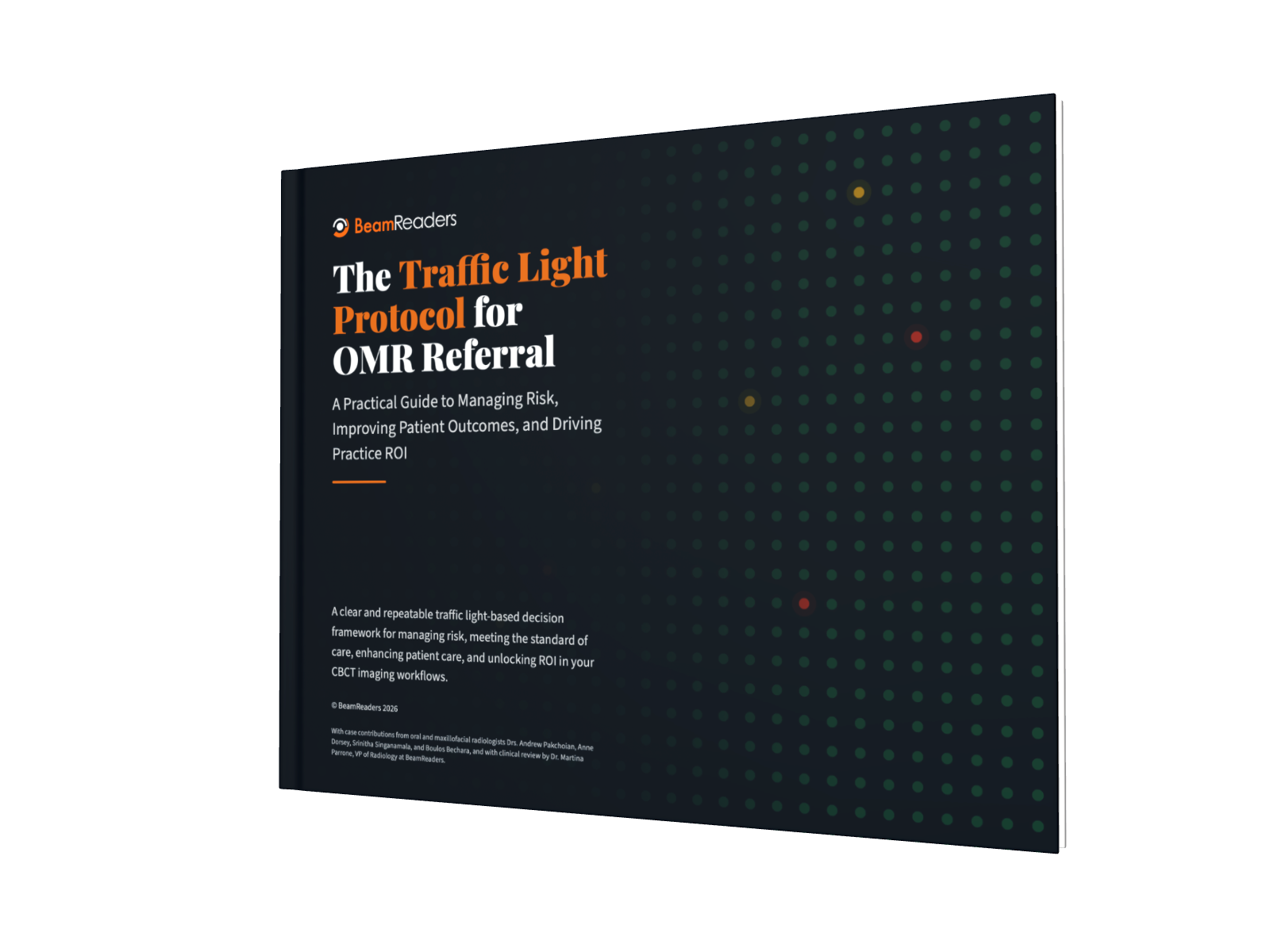
Most clinicians have heard "if you scan it, you're responsible for it", but fewer understand what that means in practice or have a system for managing it. The gap tends to get filled with assumptions: waivers, smaller FOVs, or "I'm only treating the implant site." While the instinct is understandable, the standard of care and legal reality hold practitioners accountable regardless of FOV, waiver, or intent.
The data makes clear why: nearly 4 in 5 CBCT scans contain at least one incidental finding, and almost 40% of those findings require treatment, even in limited FOV scans. (1, 2)
Managing that risk does not mean you need to become an OMR, nor does it mean you should refer every scan. The key is having a clear protocol for knowing which cases you can confidently self-interpret, which warrant caution, and which need OMR review.
In this eBook, we distill nearly 20 years and 900,000+ CBCT interpretations into practical frameworks you can use immediately. You'll learn:
- How the standard of care has evolved and current legal expectations around CBCT interpretation
- A traffic-light approach to understand and categorize your scans' risk profiles: self-interpret with confidence (green), proceed with caution based on your knowledge (yellow), and refer to an OMR for review (red)
- Ways to put this protocol into practice, with documentation and patient communication templates around 3D imaging and incidental findings
- How these protocols can drive your practice's ROI through better diagnostic accuracy, case acceptance, and referrals
Download your free copy
Why Download This Guide?
Make Referral Decisions with Confidence
Use a clear traffic-light framework to determine when a CBCT can be self-interpreted, when caution is needed, and when OMR review is the safest path.
Protect Your Practice with Defensible Documentation
Learn exactly what to document for CBCT self-reads, with practical templates that align your workflow to today’s standard of care.
Improve Outcomes While Driving Growth
Apply proven communication and collaboration workflows that strengthen diagnostic accuracy, increase case acceptance, and build referral confidence.
1 Dental and Maxillofacial Cone Beam CT, MDPI 2022
2 Frequency and types of incidental findings on limited field of view CBCT scans
This guide is intended for educational purposes only and does not constitute medical or legal advice. The traffic light protocol provides general risk categorization guidance; however, clinical judgment and professional responsibility remain with the treating practitioner. BeamReaders is not liable for outcomes related to decisions made based on this framework. Readers should consult with their malpractice carriers, legal counsel, state/local regulations, and professional organizations regarding specific questions about standard of care and risk management in their jurisdiction.